

Many small manufacturers still use spreadsheets as their Material Requirements Planning (MRP) system. It’s understandable why. Spreadsheets are inexpensive, familiar, and flexible enough to organize inventory, production schedules, and customer orders. As the business grows, however, they gradually become responsible for tasks they were never designed to perform.
The problem isn’t spreadsheets themselves. The problem is expecting a spreadsheet to behave like an MRP. A spreadsheet stores data, but it doesn’t understand how materials flow through a manufacturing process or how one planning decision affects everything else.
Imagine your sales team receives an order for 500 tables. Before accepting that order, a production manager needs answers to several questions. Do we have enough wood? Will we have enough screws next week? Should we place another purchase order today? Will accepting this order create shortages for another customer already scheduled for production? Those questions are critical, yet a spreadsheet can’t answer them automatically.
Instead, someone has to calculate everything manually. Inventory must be checked, formulas reviewed, Bills of Materials expanded, and future production considered. Every new customer order, production order, purchase, or schedule change requires another round of manual updates. The planning process slowly becomes dependent on spreadsheets instead of supported by them.
Eventually, a formula is broken. Someone forgets to update a worksheet. A value is copied incorrectly. These mistakes usually go unnoticed because spreadsheets don’t validate the manufacturing plan—they simply display whatever data was entered.
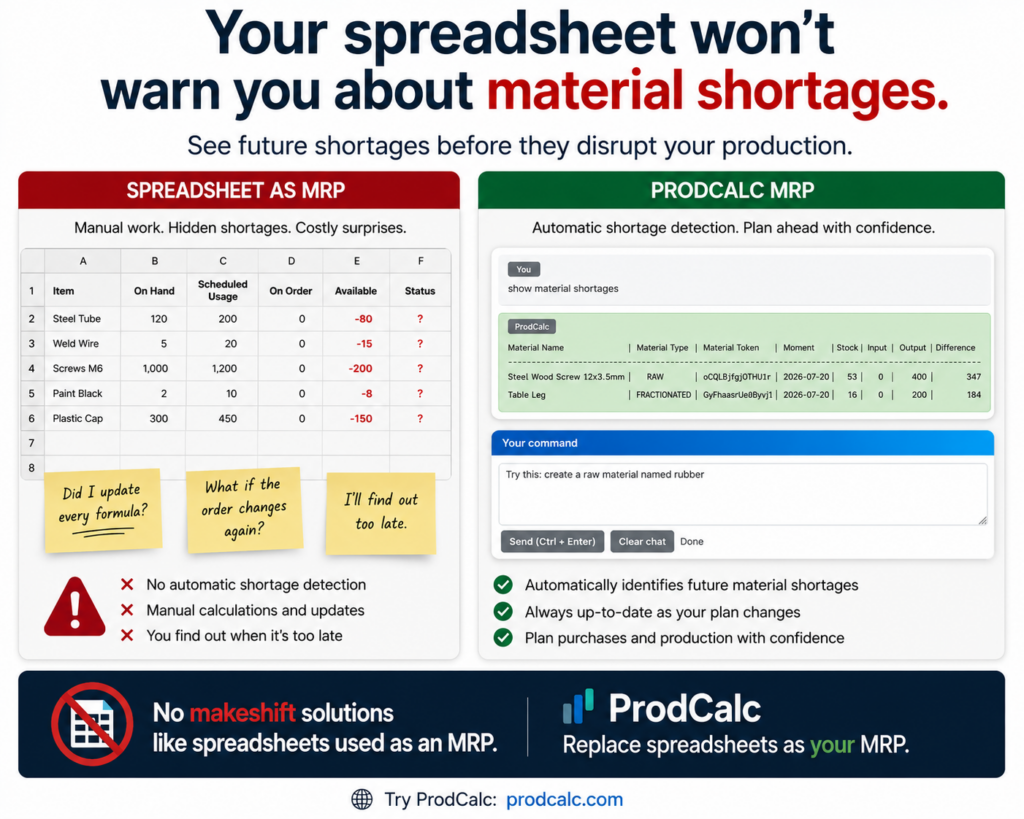
The biggest problem isn’t inaccurate inventory. It’s the inability to see into the future. Today’s inventory may appear sufficient, but after considering planned production and future customer deliveries, a critical material could be missing next Tuesday. Unfortunately, a spreadsheet won’t warn you about that. The shortage is often discovered only when production is ready to begin.
At that point, the company enters crisis mode. Purchasing becomes urgent, production schedules must be rearranged, and delivery commitments are put at risk. Everyone is working hard, but they’re reacting to a problem that could have been identified days or even weeks earlier.
This is exactly why Material Requirements Planning systems exist. An MRP continuously projects future inventory by combining current stock, Bills of Materials, Production Orders, Input Forecasts, and Output Forecasts. Instead of showing only what you have today, it predicts what you’ll have on every future planning date.
When the system detects that a material will become unavailable, it alerts the production manager before production is interrupted. That gives the business time to make informed decisions, whether that means increasing future purchases, creating additional production orders, adjusting production schedules, or negotiating a different delivery date with a customer.
Spreadsheets remain excellent tools for analysis, calculations, and reporting. They simply weren’t designed to coordinate purchasing, inventory, and production planning across an entire manufacturing operation. Using spreadsheets as an MRP becomes a makeshift solution that grows more fragile as the business becomes more complex.
That’s why we built ProdCalc. Instead of manually maintaining formulas and hoping nothing is overlooked, ProdCalc continuously projects future inventory and automatically identifies material shortages before they become production problems. Production managers spend less time maintaining spreadsheets and more time making informed planning decisions.
No makeshift solutions like spreadsheets used as an MRP.
Replace spreadsheets as your MRP with ProdCalc.
Comments
One response to “Your Spreadsheet Won’t Warn You About Material Shortages”
[…] RelatedYour Spreadsheet Won’t Warn You About Material Shortages […]