
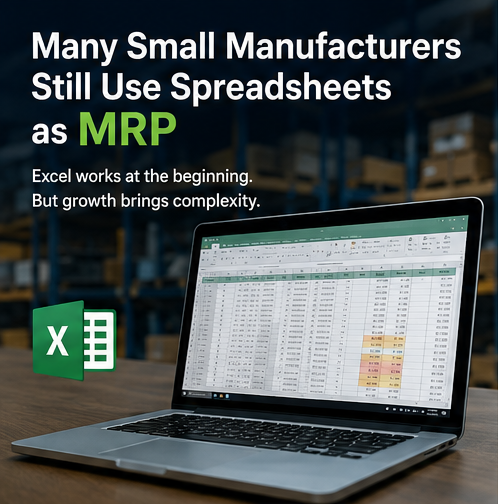
Many small manufacturing companies still use spreadsheets as their MRP system, and honestly, this is far more common than most people realize.
Inside many factories, the entire production planning process still depends on Excel files maintained manually by the PPC team. Inventory is controlled in one spreadsheet, BOM structures are stored in another, purchase orders are tracked separately, and production schedules are updated manually every day.
For small manufacturers, spreadsheets often become the “system” simply because they are accessible, flexible, and familiar to everyone involved in the operation.
Why Spreadsheets Become the Default MRP
At the beginning, spreadsheets usually work reasonably well.
A small manufacturing operation with a limited number of products and relatively simple production flows can often manage planning through Excel without major issues. Spreadsheets are fast to implement, require little training, and allow companies to organize production data without investing in expensive ERP or MRP software.
For many small factories, Excel becomes the easiest and most affordable solution available.
The problem starts appearing as the operation grows.
The Problems of Using Excel as an MRP System
As production volume increases and product structures become more complex, spreadsheets begin creating operational limitations that are difficult to manage manually.
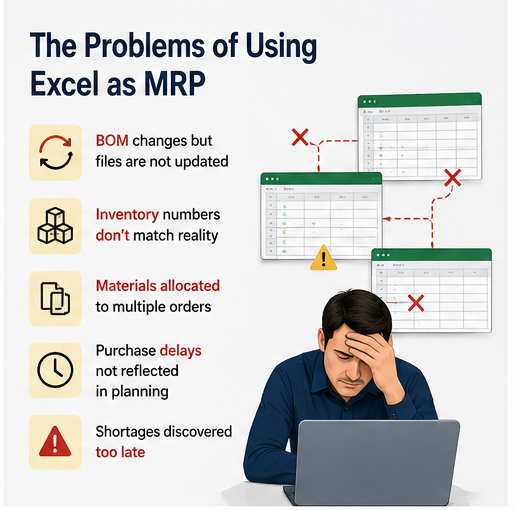
A BOM changes but another file is not updated. Inventory numbers stop matching the physical stock. Materials become allocated to multiple production orders at the same time. Purchase delays are not reflected correctly in production planning. In many cases, material shortages are only discovered after production has already been scheduled.
Over time, the PPC team starts spending more time maintaining spreadsheets than actually planning production.
Instead of focusing on manufacturing efficiency and decision-making, the operation becomes dependent on manual verification, spreadsheet maintenance, and constant data validation.
Why Spreadsheets Do Not Scale Well
The issue is not that spreadsheets are bad tools.
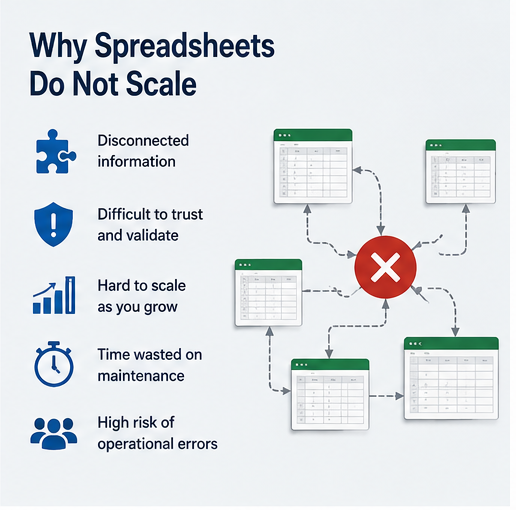
Spreadsheets are excellent for calculations, organization, and operational flexibility. The real problem is that spreadsheets were never designed to function as a complete manufacturing MRP system.
A proper MRP software needs to connect BOMs, inventory, production orders, purchase orders, lead times, and material requirements automatically inside the same logic.
When all this information is controlled manually across multiple spreadsheets, the process becomes increasingly difficult to trust, difficult to scale, and highly vulnerable to operational mistakes.
This situation is extremely common among small manufacturers because traditional ERP and MRP systems are often expensive, complex, and difficult to implement.
Small Manufacturers Also Need Real MRP Software
Many smaller factories do not have the budget, time, or technical resources required for large enterprise ERP systems.
As a result, spreadsheets remain the most accessible option even after the manufacturing operation has already outgrown manual planning.
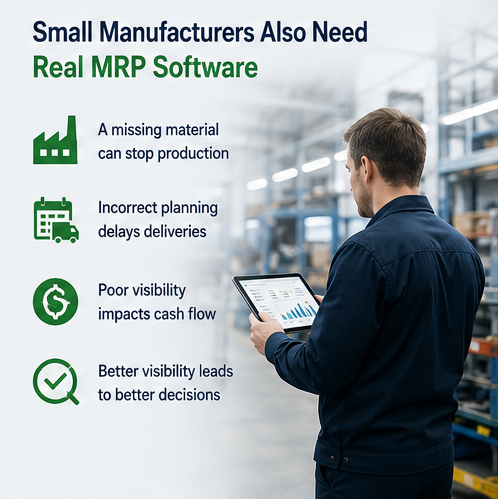
But small manufacturers also need visibility, organization, and reliable material planning.
A missing material can stop production entirely. Incorrect inventory balances can delay deliveries. Poor purchasing visibility can directly affect cash flow and customer deadlines.
The need for a proper MRP system is not exclusive to large manufacturers.
Why ProdCalc Was Created
This is one of the reasons why ProdCalc was created.
ProdCalc is a free online MRP designed especially for small manufacturing companies that still use spreadsheets for production planning, inventory management, and material control.
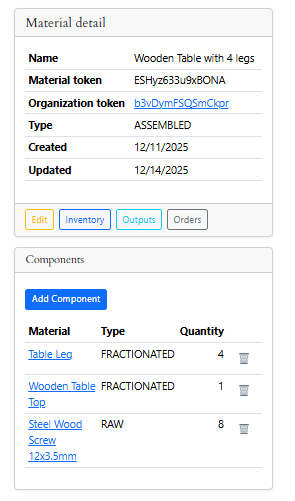
Instead of manually connecting information across multiple Excel files, ProdCalc centralizes manufacturing data inside a real MRP environment built specifically for small factories.
Manufacturers can manage:
- BOM structures
- Inventory
- Purchase orders
- Production orders
- Material requirements
- Material shortages
—all inside a single system designed to simplify manufacturing operations without unnecessary complexity.
A Free MRP for Small Manufacturers
The goal is not to replace the way companies already plan production.
Every factory has its own workflow, processes, and operational reality. ProdCalc was created to replace the spreadsheet logic behind material calculations while keeping production planning practical, accessible, and easy to use for small manufacturers.
Small manufacturing companies also deserve access to real MRP software without high implementation costs, expensive licenses, or the complexity normally associated with traditional ERP systems.
ProdCalc is free for everyone — and will always be.

Comments
2 responses to “Many Small Manufacturers Still Use Spreadsheets as MRP”
[…] Challenge: Many small shops mistake inventory management for full MRP until they realize they can’t calculate […]
[…] Many small manufacturers still use spreadsheets as their Material Requirements Planning (MRP) system. It’s understandable why. Spreadsheets are inexpensive, familiar, and flexible enough to organize inventory, production schedules, and customer orders. As the business grows, however, they gradually become responsible for tasks they were never designed to perform. […]