
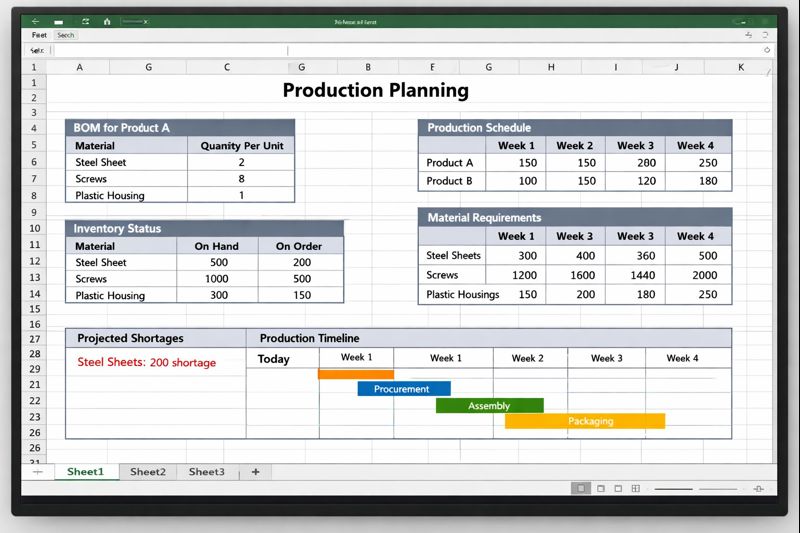
Spreadsheets have been part of production planning for decades. They are familiar, flexible, and easy to start with. But as manufacturing operations grow, spreadsheets quickly become a source of risk instead of control.
Production planning is not just about numbers — it’s about timing, dependencies, materials, inventory, and coordination across teams and suppliers. This is where spreadsheets reach their limits.
The Hidden Problems with Spreadsheets in Manufacturing
Many manufacturing companies rely on spreadsheets to manage production, inventory, and material requirements. Over time, this approach creates structural problems:
- No centralized database
Production data lives in multiple files, folders, and versions. There is no single source of truth for materials, inventory, or production orders. - Manual updates and errors
Every formula change, copy-paste action, or version duplication increases the risk of mistakes that propagate across plans. - Lack of real MRP logic
Spreadsheets do not naturally model material dependencies, lead times, or time-phased demand. MRP calculations must be recreated manually — and often incorrectly.
A Simple Example: Planning a Wooden Table with Spreadsheets
Imagine a small manufacturer that produces wooden tables.
The production planner uses a spreadsheet to plan the next month:
- 200 wooden tables planned
- Each table requires:
- 4 wooden legs
- 1 tabletop panel
- Screws and finishing materials
- Inventory is checked manually at the beginning of the month
Midway through the month:
- A new order increases demand by 60 tables
- The spreadsheet is updated
- Another team updates a different file for inventory consumption
- There is no centralized database synchronizing these changes
- The shortage of wooden legs is only discovered when the assembly line stops
The spreadsheets contained the data — but not in a shared, time-based, or consistent model.
From Spreadsheets to a Structured MRP Model
ProdCalc replaces spreadsheets by providing a centralized, MRP-driven planning environment built specifically for manufacturing.
Instead of isolated files, ProdCalc connects:
- Materials and product structures (BOMs)
- Inventory levels and movements
- Material input and output forecasts
- Production orders and timelines
All planning data lives in a single, structured database and is recalculated automatically as conditions change.
How ProdCalc Changes the Same Example
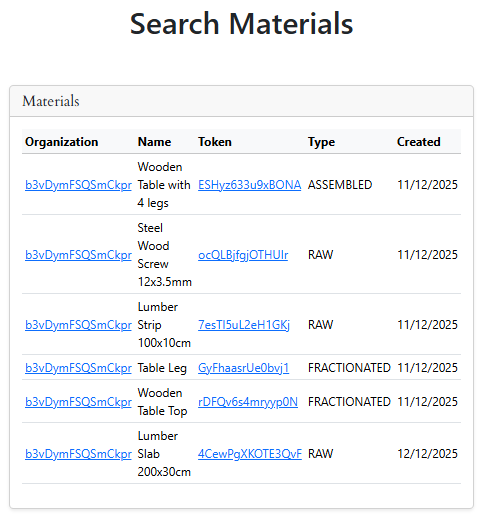
Using ProdCalc, the wooden table manufacturer would see:
- A single source of truth for materials, inventory, and production orders
- Automatic recalculation when table demand increases
- Projected shortages of wooden legs or panels weeks in advance
- Production orders flagged before execution
Instead of reacting to a stopped assembly line, the company acts earlier — when corrective action is still possible.
Built for Collaboration, Not Files
Unlike spreadsheets, ProdCalc is designed to be shared.
Manufacturing organizations maintain ownership of their planning data, while suppliers can analyze structured material usage across the platform. This allows manufacturers to be found by relevant industrial suppliers based on real planning data.
The result is clearer communication, better sourcing decisions, and fewer production interruptions.
Replacing Spreadsheets Is Not About Complexity
Switching from spreadsheets to ProdCalc is not about adding bureaucracy. It’s about replacing fragile, disconnected tools with a system that reflects how manufacturing actually works.
If production planning matters to your operation, spreadsheets should not be the system of record.
ProdCalc provides that system.
We’d really value your perspective — tell us how ProdCalc could be improved to better replace spreadsheets in your production planning.
Comments
2 responses to “Why Spreadsheets Fall Short in Production Planning — and How ProdCalc Replaces Them”
[…] to multiple production orders at the same time. Purchase delays are not reflected correctly in production planning. In many cases, material shortages are only discovered after production has already been […]
[…] RelatedWhy Spreadsheets Fall Short in Production Planning — and How ProdCalc Replaces Them […]