
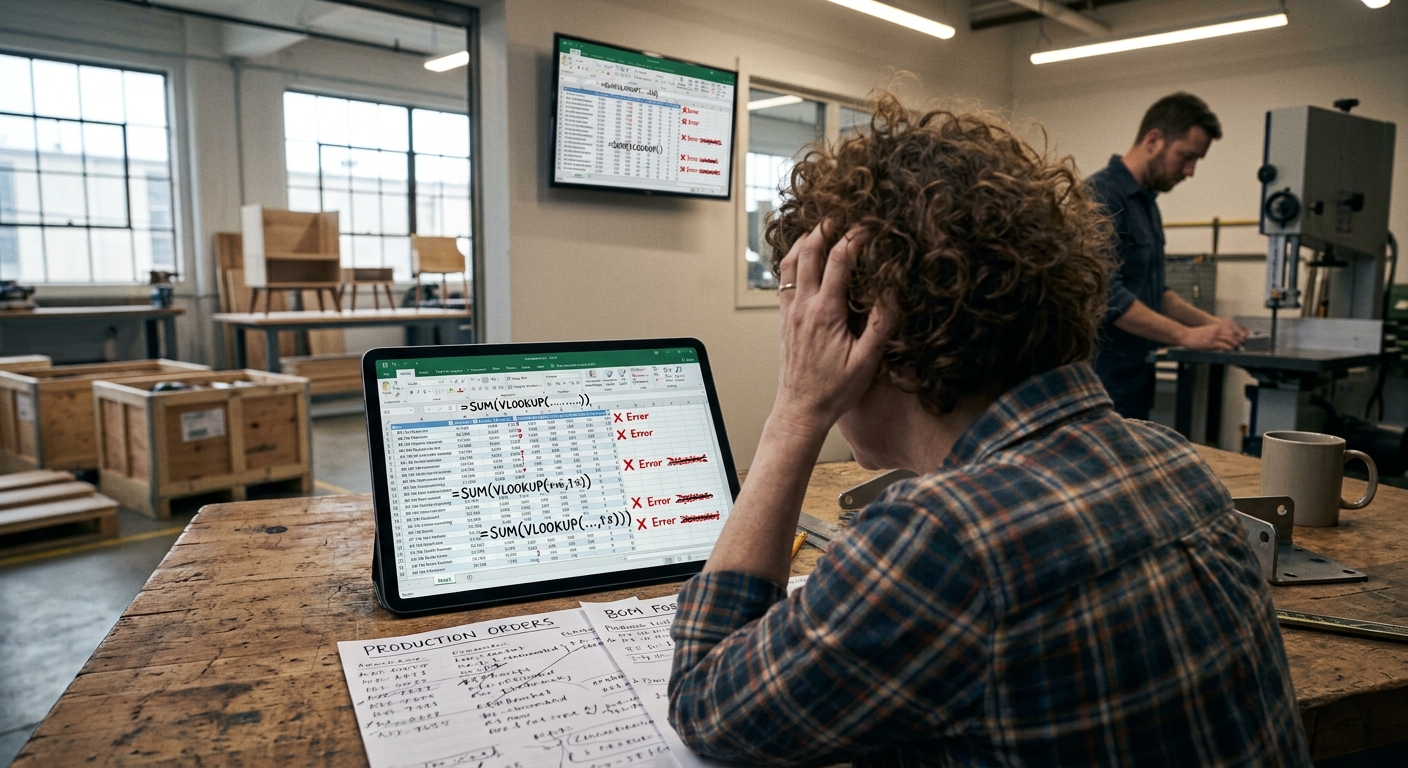
When you target small-to-medium manufacturers using spreadsheets, you are not just competing with Microsoft Excel and Google Sheets. You are competing with an entire landscape of alternative solutions—some explicit, others implicit—that operational managers rely on to avoid buying a full enterprise ERP.
Here is a breakdown of who and what you are actually competing against:
1. Dedicated “Lightweight” / Modern SMB MRPs
These are modern SaaS platforms specifically designed for SMB manufacturers to replace spreadsheets. They are usually your direct software competitors:
- Katana Cloud Manufacturing: Very popular with modern DTC, hardware, and light manufacturing SMBs. Strong Shopify/WooCommerce integrations, slick UI, and quick setup.
- MRPEasy: Purpose-built for small manufacturers (10–200 employees). Simple, no-frills, highly functional, and low cost.
- Craftybase: Targeted heavily at smaller/artisan production, DTC, and small-batch assembly.
- Odoo (MRP Module): Modular open-source ERP. Very cheap to start, highly customizable, though setup can get complex.
2. Digital “Super-Spreadsheets” & No-Code Databases
Many ops teams abandon pure Excel not for an MRP, but for flexible no-code tools that feel like spreadsheets but add relational database power:
- Airtable / Monday.com / Notion: Operations leads often build custom inventory, BOM, and purchasing trackers here using pre-made manufacturing templates.
- Smartsheet: Highly popular in traditional manufacturing because it looks like Excel, but adds project tracking, automated workflows, and multi-user controls.
Why they like these: They preserve the total customization and flexibility of spreadsheets without forcing rigid MRP workflows.
3. Inventory-Centric / Stock Management Tools
Some companies think they need an MRP, but what they actually buy is just an inventory tracking system:
- Sortly / Unleashed / Cin7 / QuickBooks Commerce: These tools focus heavily on stock levels, order management, and purchase orders, but lack complex multi-level BOM exploding or capacity planning.
The Challenge: Many small shops mistake inventory management for full MRP until they realize they can’t calculate component requirements for multi-stage assemblies.
4. Legacy / Entry-Level Accounting ERP Add-ons
Small manufacturers often try to stretch their accounting software as far as possible before buying a standalone MRP:
- QuickBooks Online + Manufacturing Add-ons: Using QBO with integrated assembly/inventory add-ons (or native advanced inventory in QBO Desktop).
- Xero + Inventory Add-ons: Common among UK/AU/US SMBs who want accounting and manufacturing tied tightly together.
5. Non-Software Competitors (The Hardest to Beat)
- Pen, Paper & Whiteboards: In smaller shops (5–15 employees), the “MRP” is often physical whiteboards on the shop floor, paper job traveler sheets, and verbal communication between the machinist and the shop manager.
- “Tribal Knowledge”: The shop manager or founder who has lived in the factory for 15 years and calculates safety stock and ordering schedules entirely in their head based on gut feel.
- Custom In-House Access Databases / Legacy On-Prem Software: Older shops often rely on a custom Microsoft Access database built by a contractor in 2008 or legacy desktop software (like Fishbowl Inventory) that they refuse to upgrade.
How to Position ProdCalc Against These Alternatives
| Competitor Category | Their Weakness | Your Winning Angle |
|---|---|---|
| Legacy / Modern SMB MRPs (Katana, MRPEasy) | Rigid onboarding, manual data entry, manual reordering setup. | “ProdCalc automates the tedious setup, data entry, and PO generation that standard MRPs force you to do manually.” |
| No-Code / Airtable | Requires endless manual building/maintenance; doesn’t handle complex BOM logic out-of-the-box. | “Purpose-built for manufacturing logic from day one, without having to build database relationships yourself.” |
| Spreadsheets / Tribal Knowledge | Human error, lack of multi-user sync, single point of failure. | “The flexibility of a spreadsheet with the automation, audit trail, and accuracy of a real MRP.” |