
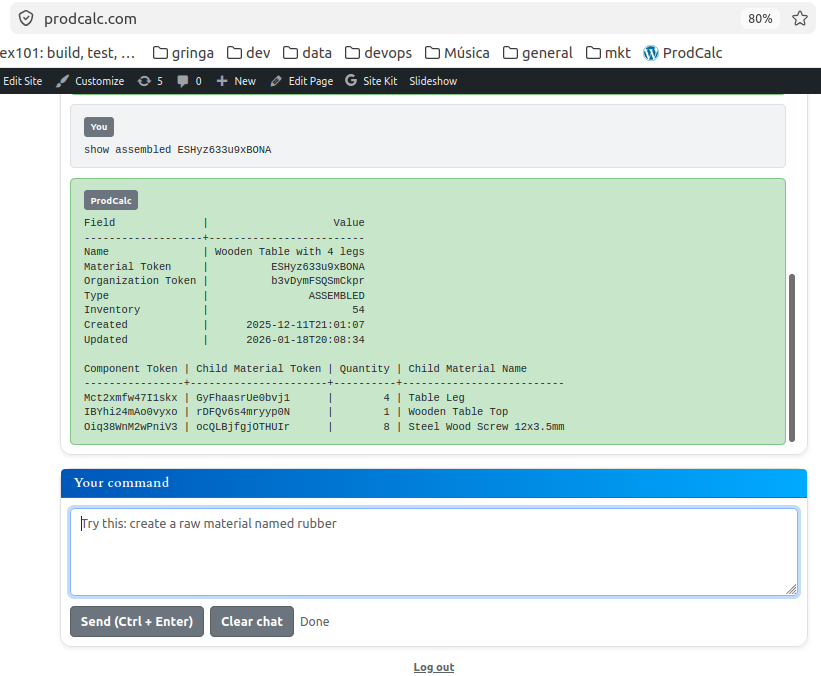
An assembled material is a material produced by combining one or more materials through a manufacturing or assembly process.
In ProdCalc, an assembled material can be created using:
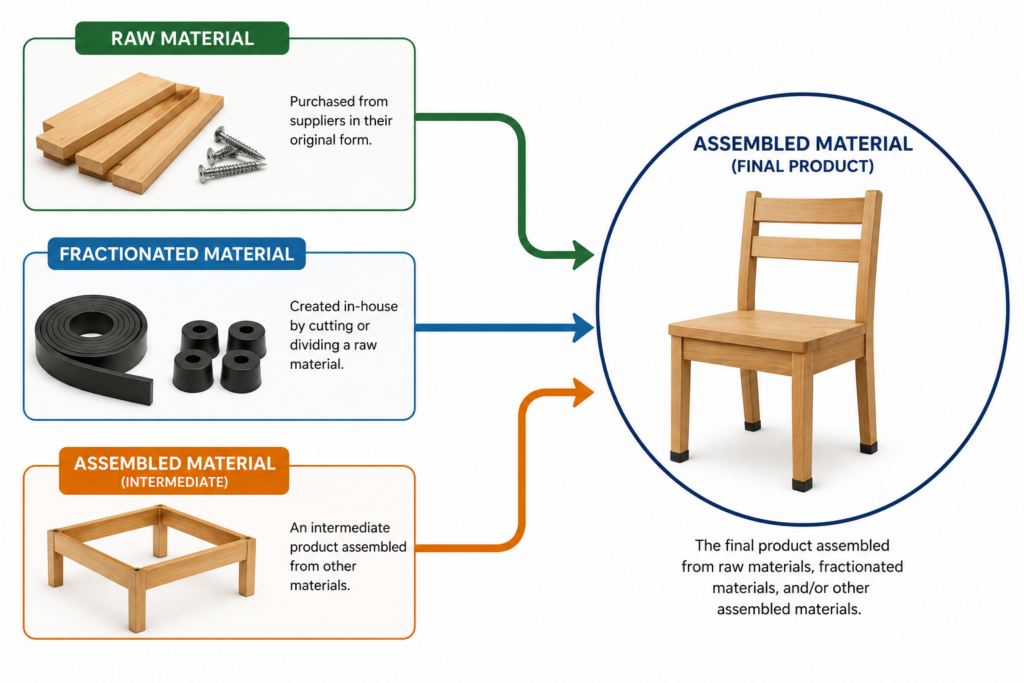
- Raw materials
- Fractionated materials
- Other assembled materials
The resulting material can be sold directly to customers or used as an intermediate component in the production of another assembled material.
What Is an Assembled Material?
Unlike a raw material, which is purchased from a supplier, an assembled material is manufactured inside your company.
Every assembled material is defined by a Bill of Materials (BOM) that specifies which materials and quantities are required to produce it.
Once produced, the assembled material becomes an inventory item that can be sold or consumed in another production process.
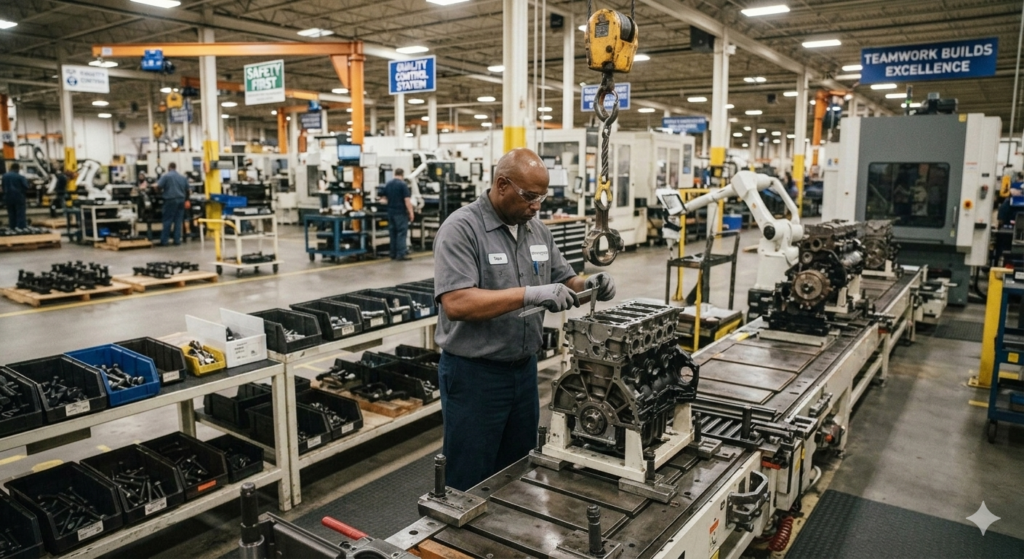
Example 1 – Furniture Manufacturing
A furniture manufacturer builds a wooden chair.
Raw Materials
- Wooden boards
- Screws
- Wood glue
- Varnish
Fractionated Materials
- Rubber feet (created from a rubber strip)
Assembled Material
- Wooden Chair
The chair can now be sold directly to customers.
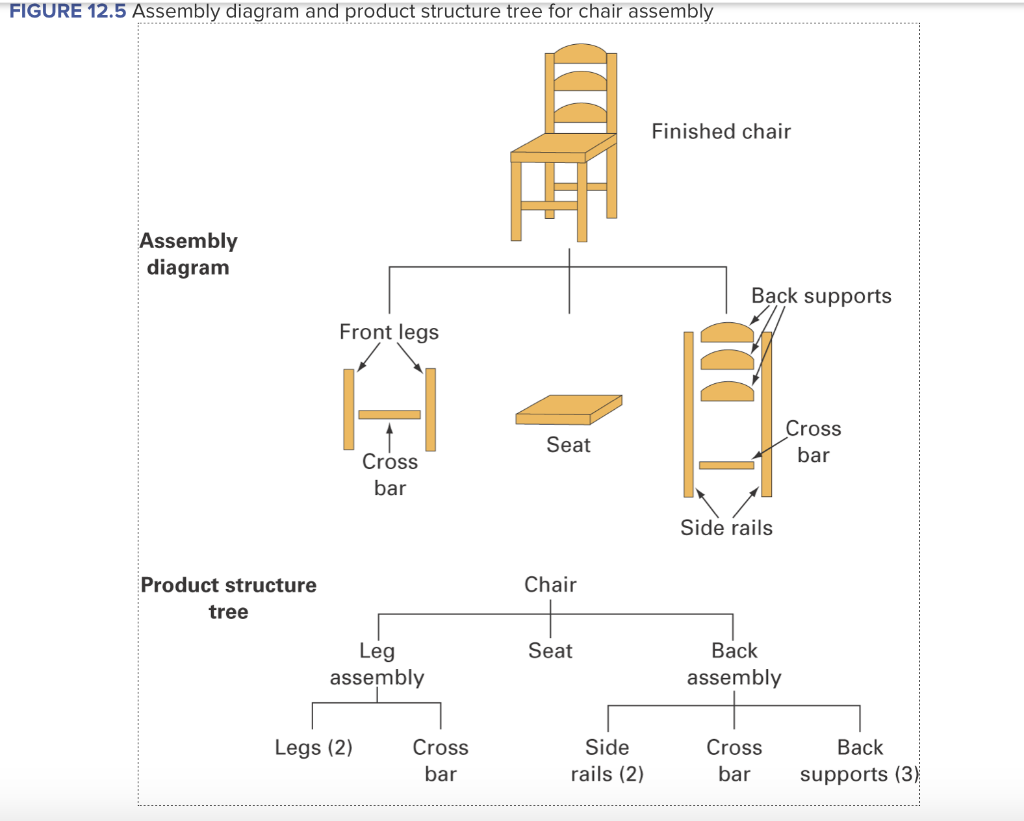
Example 2 – Bicycle Manufacturing
A bicycle manufacturer purchases individual components.
Raw Materials
- Tires
- Chain
- Bolts
Assembled Materials
- Bicycle Frame
- Wheel Assembly
- Handlebar Assembly
Final Assembled Material
- Bicycle
Notice that the bicycle is assembled using both purchased materials and other assembled materials.
Example 3 – Computer Manufacturing
A computer manufacturer assembles several intermediate products.
Raw Materials
- Memory modules
- SSD
- Power supply
Assembled Materials
- Motherboard Assembly
- Computer Case Assembly
Final Assembled Material
- Desktop Computer
This demonstrates that assembled materials can contain other assembled materials.
Intermediate Assembled Materials
Not every assembled material is sold to customers.
Many companies manufacture intermediate products that are later used to produce more complex products.
For example:
Steel Tubes
        │
        ▼
Table Frame
        │
        ▼
Office Table
In this example:
- Steel Tubes are raw materials.
- Table Frame is an intermediate assembled material.
- Office Table is the final assembled material sold to customers.
Using intermediate assemblies simplifies Bills of Materials and makes production planning easier.
Bills of Materials (BOM)
Every assembled material has a Bill of Materials (BOM).
The BOM defines:
- Which materials are required.
- The quantity of each material.
- The relationship between components and the assembled material.
When a Production Order is created, ProdCalc uses the BOM to calculate:
- Material consumption.
- Inventory availability.
- Material shortages.
- Required purchases.
Benefits of Assembled Materials
Using assembled materials allows manufacturers to:
- Build complex products from simpler components.
- Reuse intermediate assemblies in multiple products.
- Simplify Bills of Materials.
- Improve production planning.
- Calculate material shortages automatically.
- Maintain accurate inventory at every production stage.
Real-World Examples
| Final Product | Raw Materials | Intermediate Assemblies |
|---|---|---|
| Wooden Chair | Wood, screws, glue, varnish | Seat Assembly, Backrest Assembly |
| Bicycle | Tires, chain, bolts | Frame, Wheel Assembly |
| Desktop Computer | SSD, memory, power supply | Motherboard Assembly |
| Kitchen Cabinet | Wood panels, hinges, screws | Cabinet Door |
| Office Desk | Steel tubes, wood panels | Metal Frame |
Try It Yourself
Open the ProdCalc AI and type:
Create an assembled material named Wooden Chair.
Then create its Bill of Materials:
Add 4 Wooden Legs, 1 Seat Panel, 1 Backrest, 16 Screws, and 4 Rubber Feet to the Wooden Chair BOM.
ProdCalc will use this information to calculate inventory consumption, material shortages, and production requirements whenever a Production Order for the Wooden Chair is created.